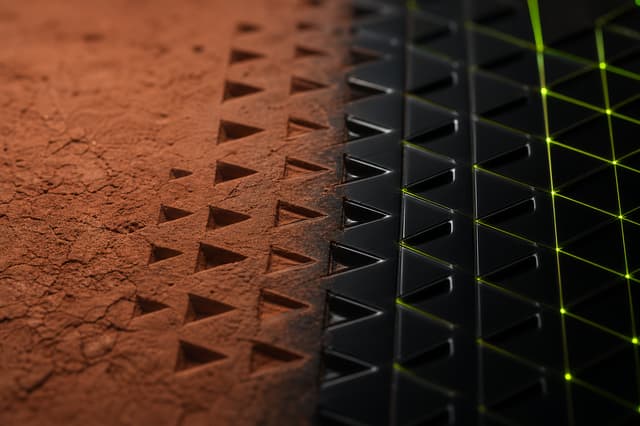
03Origin / Ugarit · Syria
From here, further.
From the east, toward what has not been built yet.
ARTISTIC INTERPRETATION / QIDMU
The name, in our words
Origin. Direction. Beyond.
Origin
A place to begin.From Ugarit, a trace carried into the present.
Direction
A course of our own.The place gives us a beginning. What we make gives us a direction.
Beyond
Room for the unwritten.What comes next may be something we have not yet named.
A contemporary reading of the name, not a translation of its individual letters.
Behind the name · language, place and sources
The name, precisely
The consonants are preserved. The vowels are reconstructed.
𐎖𐎄𐎎 records Q–D–M. Ugaritic lexicography associates the noun with east; the same written form is also attested in the semantic field of before and in front. Because alphabetic Ugaritic does not fully record vowels, scholars reconstruct the ancient vocalization.
QIDMU is the contemporary form chosen for the company—not a claim that one ancient pronunciation is certain.
Q-D-M · east · before / in front · an Ugaritic consonantal form
From the east, toward what has not been built yet.
The place behind the signs
A connected city, not an isolated relic.
Ugarit was a working system of exchange on the coast of present-day Syria. Goods, languages, writing systems, law, craft, and ideas moved through the city between the Mediterranean and inland routes.
North of Latakia
The archaeological site at Ras Shamra lies on the Syrian coast, near the port site of Minet el-Beida.
Excavations begin
Regular excavations began after a chance 1928 tomb discovery; texts later identified Ras Shamra as ancient Ugarit.
Alphabetic signs
Ugaritic scribes used a cuneiform alphabet of thirty signs, primarily for the local language.
Writing systems
The archive reflects several languages and writing systems—a material record of a connected Levantine kingdom.
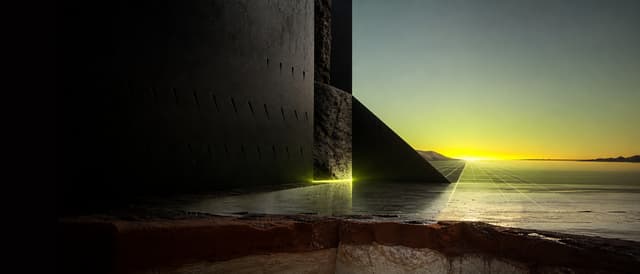
From the east, toward what has not been built yet.
Thirty signs, built to work
Complexity reduced into a usable system.
The Ugaritic alphabet is an essential link in the history of alphabetic writing. It was practical, local, and capable of carrying administration, ritual, teaching, and literature. The archaeological mission also cautions that it does not appear to have had a direct heir and should not be presented as the parent of every later alphabet.
What we carry forward
Not antiquity as decoration. A precedent for systems.
- 01
Local intelligence with international reach.
- 02
Different languages working inside one connected world.
- 03
A limited set of signs made capable of carrying complexity.
- 04
Invention grounded in place, but not confined by it.
A contemporary line—not a historical translationWhat we inherit is a beginning. What we make is a direction.
Research record
The sources remain visible.
Historical claims on this page are kept separate from QIDMU’s interpretation. The generated artwork is identified as interpretation, never as archaeological evidence.
Accuracy note: Ugarit is on Syria’s UNESCO Tentative List; it is not currently presented here as an inscribed World Heritage Site. Last reviewed 30 July 2026.